Computational work

GenIA DB project

The GenIA database is a unique resource that aims at centralising and harmonising knowledge on all genetically driven immune-related disorders. We strive to keep an updated catalog of all Inborn Errors of Immunity (IEI) and to record any patient, family and variant in any immune-relevant gene ever published in the literature.

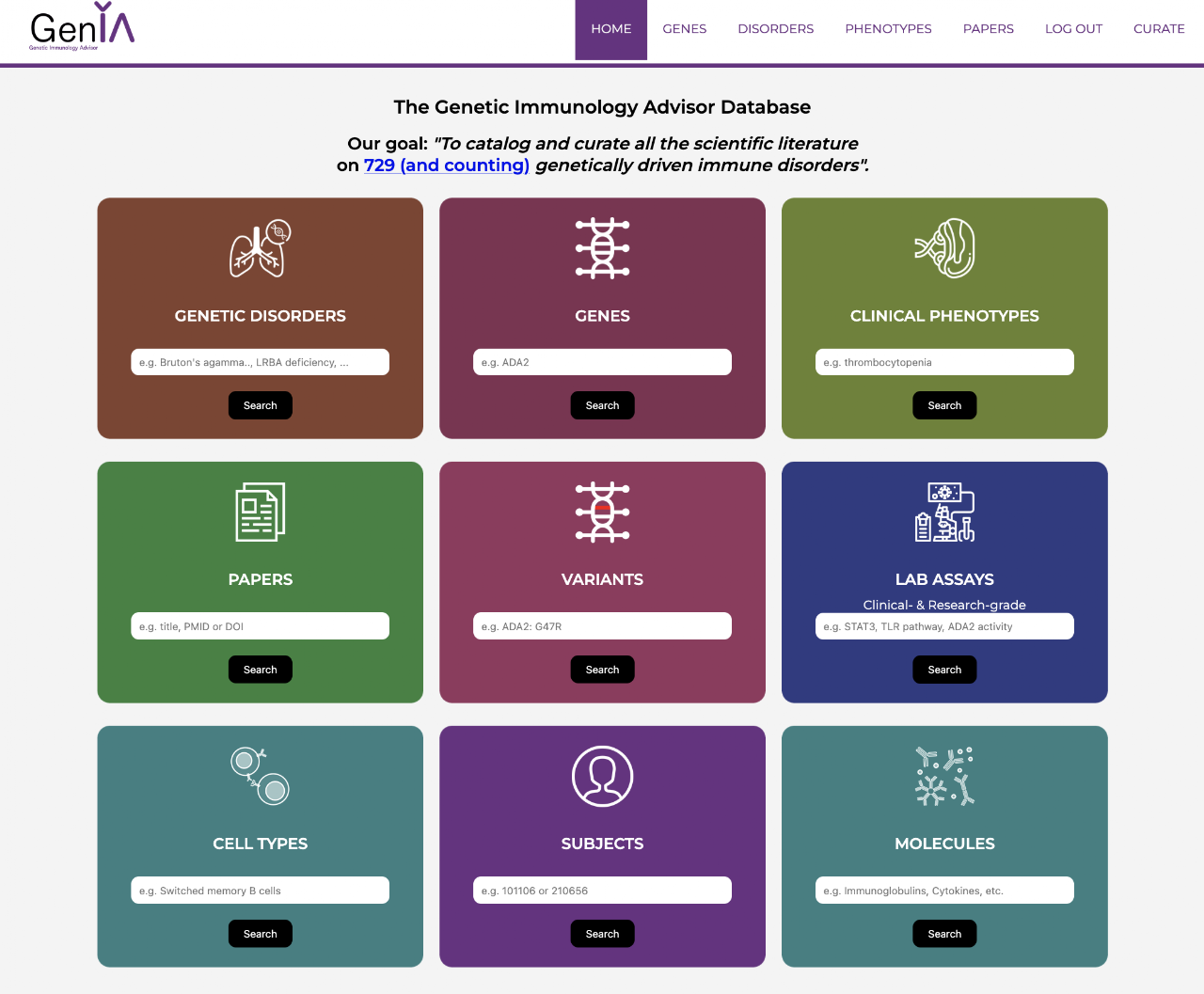
A user-friendly interface

GenIA DB overview

A curated database for Genetic Errors of Immunity

GenIA unifies disorder-level knowledge with case-level evidence to support interpretation of variants and phenotypes in the context of inborn errors of immunity. The platform is designed to improve discoverability, consistency, and translational utility of published findings.

Literature curation
Published case reports and variant findings are organized in a structured, searchable format.
Knowledge harmonization
Disorders, phenotypes, and genes are normalized to support coherent cross-study comparisons.
Public-facing utility
Clinicians and researchers can use GenIA as a shared reference for genetic immune dysregulation.

Publications & ongoing projects using GenIA

GenIA is being continuously expanded through gene- & disease-focused curation efforts.

  1. 2026: Clinical and functional assessment of heterozygous variants in CTLA4 [Submitted for publication].
  2. 2026: Genotype-Phenotype Analysis in 333 individuals with heterozygous variants in NFKB1 [Submitted for publication].
  3. 2026: Unexpected genetically determined immune dysregulation with liver involvement: GIMAP5 therapeutic dilemmas between targeted therapy and HSCT. M Moratti et al. Frontiers in Immunology.
  4. 2024: OTULIN-related conditions: report of a new case and review of the literature using GenIA. A Caballero-Oteyza, L Crisponi, XP Peng, H Wang, P Mrovecova, S Olla, et al. Clinical Immunology, 110292.
  5. 2023: GenIA, the Genetic Immunology Advisor database for inborn errors of immunity. A Caballero-Oteyza, L Crisponi, XP Peng, K Yauy, S Volpi, S Giardino, et al. Journal of Allergy and Clinical Immunology 153 (3), 831-843.